Expatriate benefits
Expatriate salaries and benefits

Since very few employees like the idea of being sent abroad for a limited time, many companies offer special expatriate benefits and other financial incentives for those who are willing to relocate.
In many cases, the assignment abroad is accompanied by a significant salary increase. So many expatriates receive expatriate salaries that are considerably higher than the salaries the earnt at home. In addition, they normally also receive a considerable amount of expatriate benefits.
When evaluating expatriate salaries, it is important to remember that salary increases represent not only an incentive for overcoming the problems of moving abroad, but also usually reflect a significant increase in responsibility assigned to the employee. Expatriates working abroad normally have less corporate support than at home and often have to take more decisions on their own.
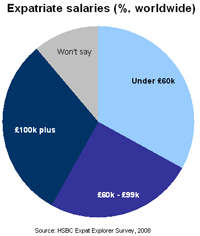
Expatriate salaries and benefits also reflect the higher cost of living abroad. Besides direct relocation costs, many expatriates have to pay for additional expenses abroad, eg. private education for children or health insurance, as well as travel home. In addition, many major expatriate destinations like Paris, London, Dubai or Hong Kong are often as expensive (or more) expensive than home.
When evaluating expatriate salaries, companies should clearly communicate which part of a salary increase reflects an increase in responsibility and which part reflect the different cost of living. This makes it easier to justify different expatriate packages for different employees and also prepares expatriates for potential salary decreases upon the return to their home country. Of course, the cost of living should be adapted to the special needs of expatriates instead of locals, and there are quite a few companies providing comparison data to make a sound judgement on those.
Expatriate benefits
Most expatriates receive a range of benefits that goes significantly beyond the benefits of other employees. These expatriate benefits reflect the special situation of expatriates and often include the following:
- Relocation benefits: Besides covering the cost of the actual move, relocation benefits often cover special assistance abroad, i.e. through a relocation agent.
- Accommodation benefits: If accommodation costs are significantly higher in the destination country, most companies pay their expatriates special benefits or provide subsidized or free housing. Besides financial incentives, direct help to find accommodation is appreciated by most expatriates, since the search for accommodation is generally on of the most stressful and time-consuming challenges of the move.
- Language training: Expatriate benefits for language training not only increase the professional capabilities of expatriates sent abroad, but also help them integrate better in their new environment. Ideally, the language training should start well in advance of the relocation.
- Expatriate family benefits: When sending expatriates abroad, it is important to remember that the relocation affects the whole family, especially the spouse. Family problems are therefore one of the most common reason for expatriates to break off their assignment earlier than planned. To ease the family relocation and tensions that go along with moving abroad, companies often offer support and financial help in finding schooling for kids. If the expatriate’s spouse has been working before, some companies may also help them obtain a work visa and a job to compensate for potential loss of income. Non-working expatriate spouses might receive help in finding unpaid activities (such as volunteer work or studies).
- Expatriate training and counselling: Although these are less common, training and counselling are an important part of expatriate benefits. Before departure, expatriates should receive cross-cultural training to help prepare for the challenges abroad. After their assignment abroad, expatriates could receive repatriation assistance to help them readjust back home. Since the move back is often even more challenging than the move abroad, many companies try to provide a challenging assignment upon return.
In general, expatriate packages and expatriate benefits tend to be adapted to the individual situation and assignment of each expatriate. A young single graduate going abroad will face different challenges on his move abroad than a senior manager with family and children.
In addition, the expatriate destination also has a significant impact on the expats’ situation. While some countries like China and the United Arab Emirates are often regarded as ‘hard’ destinations, Western European countries such as Spain or Germany are often viewed as easier destinations to adapt to. This is also reflected in expatriates salaries and benefits: The more difficult the destination is perceived by expatriates, the financial incentives and expatriate benefits on offer tend to be more attractive.